
They Stole Your Crypto. Now They're Offering to Recover It.

First, they steal your money. Then they offer to give it back. For a fee, of course.
There is something almost cruelly ironic about cryptocurrency recovery scams.
A victim loses $125,000 on a fraudulent investment platform. Weeks later, a recovery specialist makes contact.
Good news! The missing funds have been located.
Better still, this stranger knows exactly how much was stolen.
Quite remarkable, isn't it?
Not necessarily.
Because the recovery specialist may be the very same fraudster who stole the money in the first place.
THE FRAUDSTER KNOWS YOUR LOSSES. OF COURSE HE DOES.
In some recovery scams, the original fraudsters return under a new identity. In others, the victim's information is passed to an associated team or sold to another criminal operation.
The second fraud may therefore be organized by the same people, using information collected during the first.
They know the amount invested, the supposed account balance, the dates of the transfers and sometimes even the victim's personal circumstances.
That makes their story convincing.
But it also raises an obvious question.
How does a supposedly independent recovery company know so much about a confidential fraud case?
At SarX, that is precisely the kind of inconsistency worth investigating.
YOUR MONEY HAS BEEN FOUND. NOW PAY THE TAX.
Here comes the truly absurd part.
The supposed investigator announces that the stolen cryptocurrency has been recovered, but it cannot be released until the victim pays a tax.
Or a blockchain clearance fee.
Or an anti-money-laundering deposit.
Sometimes all three.
A tax payable to an unknown wallet to release stolen cryptocurrency? Seriously?
Real tax obligations do not arise simply because an anonymous recovery agent says they do. And anti-money-laundering compliance is not a mysterious payment that makes stolen funds legal to release.
These demands are classic warning signs of another fraud.
The victim is being asked to finance the recovery of money that may never have been recovered at all.
The first scam was an investment fraud.
The second sells hope.
THE SAME FRAUD, A DIFFERENT COSTUME
The fake investment adviser disappears.
A recovery expert appears.
The website changes. The company name changes. Perhaps even the accent on the telephone changes.
But the wallet instructions, the documents, the communication patterns or the digital infrastructure may tell a different story.
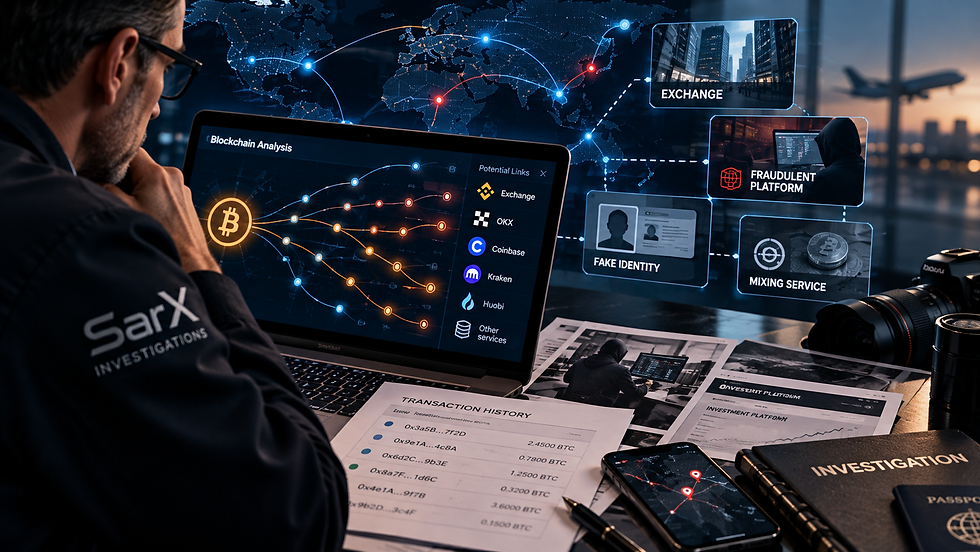
At SarX, we examine these connections through blockchain tracing, OSINT, digital evidence analysis and the verification of online identities.
The objective is to determine whether the supposed recovery operation is connected to the original fraud and to preserve evidence supporting that conclusion.
Not every unsolicited recovery offer comes from the original fraudsters. Some come from unrelated criminals who have obtained victim information.
The distinction matters. And it needs to be proven, not guessed.
DON'T PAY TO BE ROBBED TWICE
If someone contacts you claiming to have recovered your cryptocurrency, ask one question before anything else:
What independent evidence proves that you actually control my funds?
A screenshot is not evidence of control.
A blockchain diagram is not proof of recovery.
And a demand for advance taxes is certainly not proof of legitimacy.
SarX can investigate the original fraud and the supposed recovery operation, preserve relevant digital evidence and prepare a documented case for legal counsel or competent authorities.
We don't sell guaranteed recoveries.
We investigate the people who make those promises.
Philippe ChevalierSarX Private Investigations
Suspect a Cryptocurrency Recovery Scam?
Request a confidential case assessment:
Comments